I recently received an Email form a reader asking me questions about one of my earlier posts and measuring employees' work. I wanted to share...
I created this model over 30 years ago (With updates) as a guide for anyone that supervises or manages employees. It is a very common-sense approach to any new supervisor or manager that wishes to create a cohesive working team.
Envision + Enlightenment + Enablement + Execution (added in 2006) + Empowerment + Evaluate + Encouragement = Employee Excellence. I call it the 7es.
7Es for Employee Excellence - Double Click to Enlarge Pic (developed by qg -1996)
ENVISION – It is my job to relate/communicate to you the corporate, departmental, etc.… objectives into a meaningful AIM or purpose for us to follow.
Caution: If the vision cannot be described in a short amount of time (i.e., 15 minutes or less) then you have not thoroughly planned, measured and communicated a vision that will be successful. If you force the change, it may happen, but it will not be manageable or sustainable.
ENLIGHTEN (Pre-requisite to Enablement) – This is where we as a Team create an awareness, understanding and sense of urgency as to what is expected of us to meet the objectives.
Caution: If your audience is not excited or at least interested in a short amount of time (i.e., 15 minutes or less) then you may be in for a very tough time in implementing valued change. If the top echelon of leaders does not believe and equally importantly communicate and actively live out the proposed changes nothing will take place.
ENABLE (Pre-requisite to Empower) – Provide the tools, training and education to do the job in order to meet the objectives.
Caution: If you do not seek, serve and gather input from your people that are to do the work and manage the change you have done nothing other than has been done time and time again and that is create fear, mistrust and non-value-added change.
EMPOWER (Pre-requisite to Encourage) – Based on previous EEEs, provide by which we are to operate with each function/process of our work.
Caution: If the culture/environment has not been prepared/nurtured for change it will be short-lived and will not take hold. Effective leaders are sensitive to the challenges facing workers in a changing environment. Not empowering them with the authority, skills and tools to make change happen then you are doomed for another failed attempt for an efficient and effective change. Also, if you do not allow obstacles (That means people too) to be removed from preventing the change you failed as a leader.
EXECUTE (Pre-requisite to Empower) - Based on previous EEEEs, provide the methods and procedures (As developed by all stakeholders) by which we are to operate with each function/process of our work.
Caution: If you do not establish process and quality measures that can identify errors/mistakes then learning and growth will not take place. True learning and change must come through testing and correcting mistakes for improvement. If "Fear of Failure" is evident then people will provide you with false readings and numbers that will eventually leave the change effort in a tampered and damaged state.
EVALUATE (Pre-requisite to Encourage) - What Gets Planned and Measured Gets Done!
ENCOURAGE - Recognize and nurture behaviors for on-going improvements and culture change. Each of us has the responsibility to recognize and praise the good work done by others.
Caution: If you do not celebrate short wins along the implementation route then long-term change will not take place. Praise and encouragement that is delegated is worthless. Go to where the learning is being done. Be an “Active” Participant and Leader.
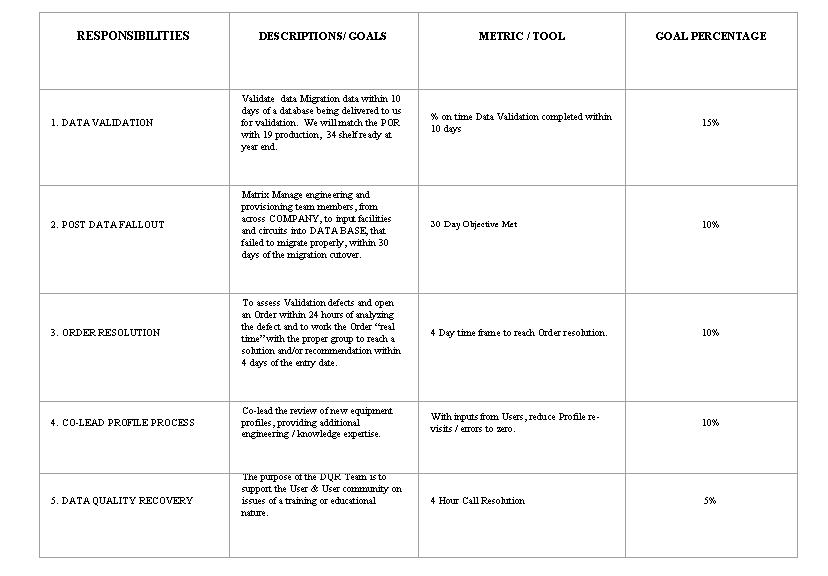
Along with the 7Es you need measures of what your employees actually do during a work week.
The following example are goals and objectives that could come from a Department Head to his/her boss.
I developed some of the examples from some of my own (names/info changed) goals and objectives from the past.
The important things to remember are to include realistic means of measure that will allow you to meet corporate goals and objectives that should have been developed first before you and your team create your own (seldom done & people wonder why they never get done or accomplished). All goals and objectives must be aligned from the top to the bottom and then communicated and EXPLAINED throughout the company (Regardless of the number of employees).
Please note that the example below (Developed by qualityg) is ahigh level example and needs to be in much more detail in the form of strategy and responsibilities.
Double CLICK on EACH Slide to Enlarge - Then Click on 4 arrows for more clarity.


I hope this provides a model that can be used for you and your employees.